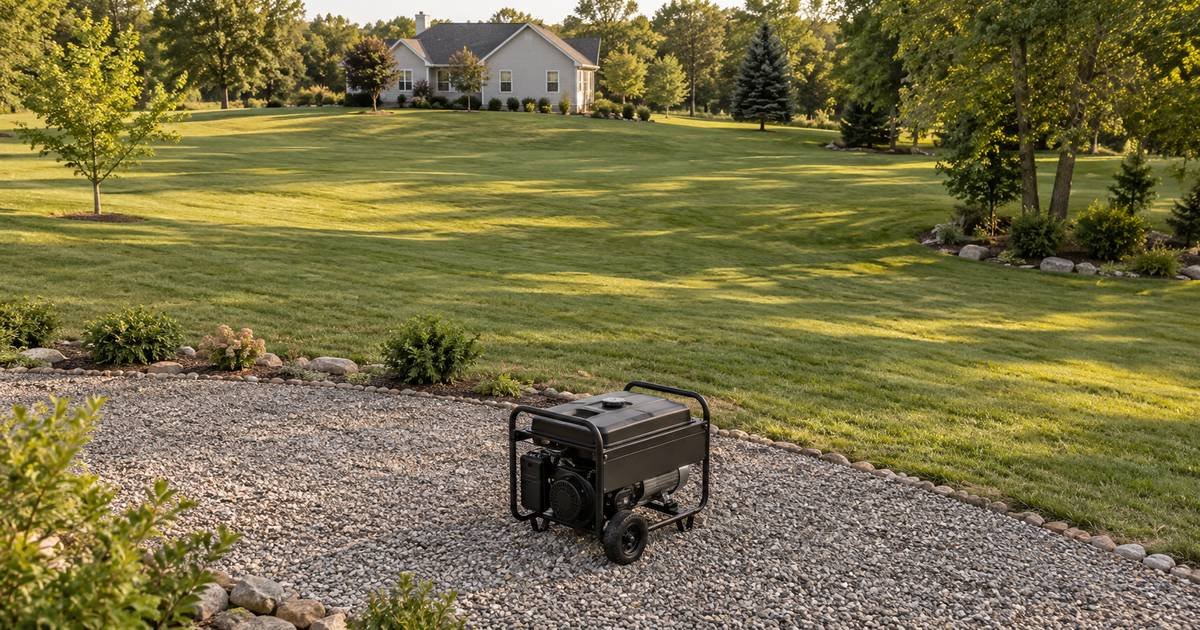
Quick answer: For a portable engine generator, CPSC specifies at least 20 feet [6.1 m] from doors, windows and vents, outdoors only. Smaller fire or cooling clearances in manuals are additional requirements, not permission to move closer. Fixed standby equipment needs a model-specific professional assessment; its wall clearance does not establish a CO-safe location.
The generator distance from house question has different reference points: a building, an opening, a combustible object and an airflow clearance. Check placement before choosing output from our generator sizing guide. A machine that fits your loads still needs somewhere suitable to operate.
Start with the generator distance from house reference point
CPSC’s portable-generator alert measures its 20-foot [6.1 m] minimum from doors, windows and vents. That is not a clearance measured only from the nearest blank wall. Identify openings around the proposed location. Keeping the exhaust outdoors does not prevent it from entering a nearby opening.
Honda’s carbon monoxide warning, p. 7 says to direct exhaust away from occupied structures. A patio outside your living room is not automatically suitable because it lacks a roof. Look beyond the wall immediately behind the engine. A neighboring building or an air intake also deserves attention.
Do this assessment before a power cut, when darkness and weather make shortcuts tempting. The outage preparedness checklist covers the broader household plan. If the available site cannot satisfy placement requirements, reconsider the backup arrangement instead of reducing the distance to make it fit.
Read fire and cooling clearances as additional requirements
Honda’s EU2200i manual, p. 9 specifies 3 feet [1 m, as printed] from buildings and other equipment for fire protection. Champion’s 201463 manual, p. 22 requires 5 feet [1.5 m] from combustible material. These selected instructions span 3–5 feet. They address heat and surrounding objects; they do not replace the portable CO warning.
| Document and hazard | Published threshold | What the measurement addresses | How to read it |
|---|---|---|---|
| CPSC portable CO alert | At least 20 ft [6.1 m, our conversion] | Doors, windows and vents | Outdoor placement; not a thermal-clearance exception |
| Honda EU2200i, fire protection | At least 3 ft [1 m as printed] | Buildings, vehicles and other equipment | Additional fire requirement, not a safe CO radius |
| Champion 201463, heat and airflow | 5 ft [1.5 m] from combustibles; 3 ft [91.4 cm] airflow | Different surrounding hazards | The same page also requires all objects 5 ft away |
| Westinghouse WGen6000, location | At least 15 ft [4.5 m as printed] | Buildings, equipment and combustible material | Older model document; does not override CPSC opening separation |

The Champion location chapter separates cooling space from combustible-material separation. Its airflow figure is not the full site requirement. The hot-exhaust warning on that same page also requires objects to remain clear. Read the complete location chapter, rather than selecting its shortest distance.
Our generator fuel-consumption guide attributes 15 feet to the WGen6000 manual. That model-specific instruction is not general portable CO guidance. The preparedness checklist applies the longer portable warning when distances differ. Do not average these figures or turn the older manual’s building clearance into permission to ignore openings.
A standby wall clearance is not its opening clearance
Briggs & Stratton’s placement explanation distinguishes openings from structures. Its closer wall placement depends on fire-tested equipment or the stated wall fire rating. Champion’s standby summary also makes closer home placement conditional on local codes. These are manufacturer summaries, not complete model-specific installation approvals.
| Published standby summary | Structure example | Opening separation | Condition you must preserve |
|---|---|---|---|
| Champion standby guidance | No less than 18 in [45.7 cm, our conversion] | At least 5 ft [1.5 m, our conversion] | Closer placement only where local codes allow |
| Briggs & Stratton placement explanation | 18 in [45.7 cm, our conversion] for stated cases | At least 5 ft [1.5 m, our conversion] | Fire-tested equipment or the stated fire-rated wall condition |
A June 2025 CPSC staff report warns that stationary-generator fire clearances did not prevent CO entry in the incidents it examined. Fire testing is not a demonstration that exhaust cannot enter a home. The report also discusses openings and building geometry, rather than treating wall separation as the only issue.
The report’s disclaimer says the Commission has not reviewed or accepted it. Its recommendations must not be presented as an adopted nationwide installation rule. Nevertheless, the documented hazard matters: a listed fire clearance is not a CO guarantee. Ask the qualified installer to evaluate exhaust exposure as well as code and model requirements.
Decide where the engine will run before choosing the load
Honda’s operating precautions require outdoor operation with unobstructed cooling and exhaust directed away from occupied structures. Westinghouse’s location chapter calls for a dry, level, well-ventilated site. An enclosed garage with its door open cannot substitute for outdoors. Distance does not cure a location that traps exhaust.
A garden corner can have space but still face an opening or block airflow. Review surrounding buildings, vegetation and weather exposure against your own manual. For permanently installed equipment, leave site selection, fuel systems and electrical work to qualified licensed professionals. A generic sketch cannot establish that an installation complies.
Placement also affects whether your chosen backup method is practical. For an indoor electrical alternative, see power station indoor safety and the unit’s own limits. A battery power station does not make a fuel-burning generator suitable indoors. Our power station recharging guide keeps charging options separate from engine placement.
Then check the generator load for a refrigerator, freezer and furnace. Appliance capacity and startup requirements determine output, not a shorter safe separation. If the site is unsuitable, a bigger engine does not solve the placement problem. Household circuit connections remain a professional electrical decision.
How we compared the placement documents
We read the complete portable-manual location and hazard chapters, including warnings beside the main text. We compared their purpose with CPSC portable guidance, standby manufacturer explanations and the stationary staff analysis. We preserved manufacturer metric rounding rather than silently changing their instructions. These selected examples are not a survey of every generator.
We did not measure exhaust dispersion, test a CO shutoff or approve any property. Wind, openings and the actual equipment instructions still matter. US source documents do not establish UK installation permission. The comparison helps you identify which question a distance answers before discussing a fixed system with an installer.
Distance cannot replace CO protection
Honda’s CO precautions require outdoor operation and battery-backed alarms; its CO-MINDER warning says shutoff cannot eliminate every hazard. Never run an engine generator in a home, garage or partly enclosed space. Keep exhaust away from occupied structures.
CPSC’s fuel warning also requires stopping and cooling before refueling. Never supply house wiring through a wall outlet. Have fixed generator installation, fuel work and electrical connections handled by qualified licensed professionals.
Frequently asked questions
How far from the house does a generator need to be?
For a portable engine generator, CPSC specifies at least 20 feet [6.1 m] from doors, windows and vents, outdoors only. Follow the generator’s other placement requirements too. A smaller fire clearance is not a CO exception. For fixed standby equipment, use a qualified installer and the actual model’s complete instructions.
What is the code distance for a generator from a house?
A portable generator distance from house warning is not the same as a fixed-installation code clearance. Manufacturer standby guidance distinguishes walls from openings and includes conditions for closer placement. Your installer must verify the adopted local rules and actual model instructions. A general internet distance cannot approve a particular property.
How much clearance do you need around a generator?
The hazard and model decide. Honda’s fire instructions and Champion’s location chapter give different thermal and airflow requirements. Those clearances remain additional to outdoor portable CO separation. Read the entire location chapter, including hot-exhaust warnings. Do not use its shortest dimension as a single safe distance for every surrounding object.
What is the 20/20 rule for generators?
Treat the slogan cautiously. CPSC’s documented placement instruction is at least 20 feet from doors, windows and vents, outdoors. Its fuel warning says to stop and cool before refueling. The documents used here do not establish a universal cooldown duration or alarm price. Follow those instructions separately instead of relying on a mnemonic.
This article is general information, not an installation guide and not a substitute for a licensed electrician. Electrical work on a service panel, a transfer switch or a utility connection is regulated in most jurisdictions and normally requires a permit and an inspection. Fuel-burning equipment produces carbon monoxide and must never be run indoors, in a garage or near an opening into the home.


